F1 Tire Compounds Explained: Soft, Medium, Hard and Wet

Tires shape almost every F1 race. Each compound trades speed for life, and teams build their strategy around that trade.
The dry compounds
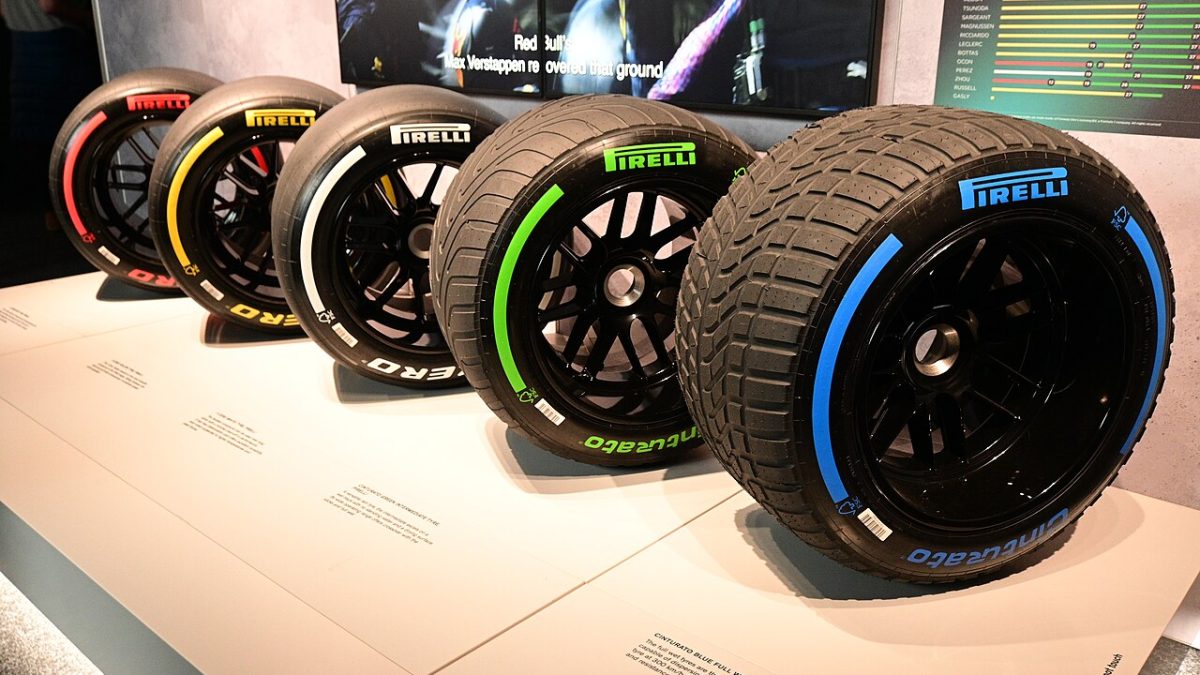
Pirelli supplies slick tires in a range from C1, the hardest, to C5, the softest. Only three are brought to each race and they are labeled hard, medium and soft. The sidewall color shows which is which: white for hard, yellow for medium and red for soft.
Softer tires grip more and give faster laps. They also wear out sooner. Harder tires last longer but are slower.
The wet weather tires
Green marks the intermediate tire for damp tracks. Blue marks the full wet tire for heavy rain. Both have grooves to move water away from the contact patch.
Why it matters on race day
Drivers must use at least two different dry compounds in a dry race unless rain changes the conditions. That rule forces at least one pit stop and creates strategy choices. A driver on fresh softs can attack. A driver on hards can stretch the stint and pit later.
Keep reading
Pit strategy also shapes the sprint format. Read F1 Sprint Explained and check the current standings to see who needs a good tire call.
The rule that forces a pit stop
In a dry race every driver must use at least two different dry compounds. That rule alone guarantees one stop for everyone, and it is why a one-stop race is still a two-compound race.
If the race is declared wet, the requirement is dropped. A driver can then run the same compound from start to finish, which is part of what makes a wet race so hard to predict.
The Q2 rule that sets the race start
The top ten on the grid do not get a free choice of starting tire. They have to start the race on the compound they set their fastest time with in Q2.
The knock-on effect is real. A driver who only just scrapes through Q2 on softs starts the race on softs and faces an early stop. A car that is comfortably quick can use the medium in Q2 and start on a tire that lasts much longer. Qualifying strategy is often decided in the second session, not the third.
Graining and blistering
Both mean a tire is being asked to do something it was not built for, and they are not the same problem.
Graining happens when the surface rubber tears and rolls up as the tire slides. Grip drops, and the driver has to wait for the loose rubber to wear away before the tire comes back. It is common on a cold track, or when a driver pushes too hard too early in a stint.
Blistering is worse. The tread overheats and lifts away from the carcass underneath. It usually means the tire has been running too hot, and it rarely recovers.
Why tires are warmed before they go on
Tires sit in heated blankets in the garage so they arrive at a pit stop close to working temperature. A cold tire has far less grip, which is how a driver on fresh rubber can lose a place on the out-lap.
The FIA also sets a minimum starting pressure for each race. Running below it would give a car more grip, so the check is part of scrutineering rather than a team choice.
What a safety car does to the plan
A safety car or virtual safety car cuts the cost of a pit stop, because the whole field is running slowly. Teams that had planned to stop later will often bring a car in early instead. Our flags guide covers the signals, and the pit stop guide covers what happens in the box.
Frequently Asked Questions
Red is soft, yellow is medium and white is hard. Green is intermediate and blue is full wet.
Pirelli.
Softer tires give more speed and wear quickly, while harder tires last longer. Teams combine them to manage race time and stops.
A dry race requires at least two different dry compounds, which forces every driver to make at least one stop. The rule is dropped if the race is declared wet.
The surface rubber tears and rolls up as the tire slides. Grip drops until the loose rubber wears away.
A cold tire has much less grip. Teams use heated blankets so the tire is close to working temperature when it goes on the car.
This article is part of our F1 rules explained guide.

Alex is the editor of Apexline, an independent Formula 1 and US motorsport site for American fans. Alex writes race previews, results and rule explainers, checks every result, point total and session time against formula1.com and the FIA, and converts race times to Eastern, Central and Pacific time. Read how we work in our editorial policy: https://vantage97.design/editorial-policy/