How F1 Qualifying Works: Q1, Q2 and Q3 Explained


F1 qualifying is the Saturday session that sets the starting grid for Sunday’s race. It runs in three knockout parts, Q1, Q2 and Q3, and each part removes the slowest cars until ten drivers fight for pole position. The fastest lap in Q3 wins pole. This guide explains each stage, the rules and the U.S. start times.
Last updated: October 25, 2026
What does F1 qualifying decide?
Qualifying decides the starting order for the race. The fastest driver starts first, the second fastest starts second, and so on down the grid. Starting near the front matters because it is easier to avoid trouble in the first corners and easier to control the pace. No championship points are awarded for qualifying. Points go to the top finishers in the race, as explained in our F1 points system guide.
How do Q1, Q2 and Q3 work?
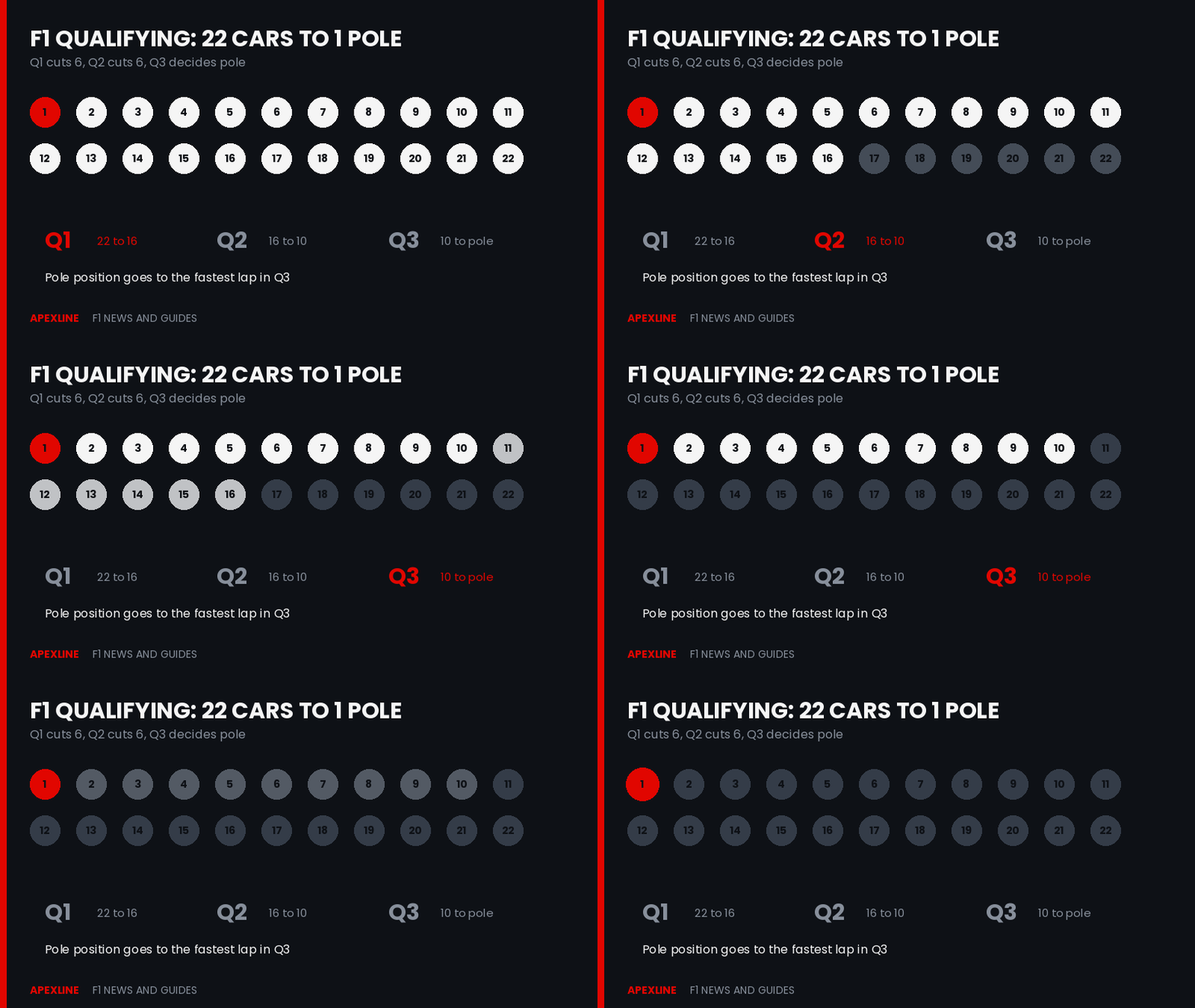
Qualifying has three knockout sessions. Slower drivers are eliminated after Q1 and Q2, and the final ten drivers fight for pole in Q3.
| Session | Length | Cars at the start | Cars eliminated | Grid spots set |
|---|---|---|---|---|
| Q1 | 18 minutes | 22 | 6 | 17th to 22nd |
| Q2 | 15 minutes | 16 | 6 | 11th to 16th |
| Q3 | 12 minutes | 10 | None | 1st to 10th |
Six cars now drop out in Q1, up from five in 2025, because Cadillac joined as the 11th team and the grid grew to 22 cars. That keeps Q2 at 16 cars.

How is the qualifying order set?
Each driver’s fastest valid lap in the session counts, timed to the thousandth of a second. A lap can be deleted if the driver runs beyond the white lines at the edge of the track, so a quick time on the screen is not final until the stewards have checked it.
What does a driver do on a qualifying lap?
A qualifying run has three parts. The driver leaves the pit lane and uses an out lap to warm the tires and brakes. Then comes the push lap, the one that counts. After the line, a cool-down lap lets the car return to the garage. A mistake on the out lap can ruin the push lap, which is why teams plan the timing of each run closely.
In Q1 the aim is simple: reach Q2. Teams often run a single set of tires for a fast lap and then wait in the garage. In Q2 the goal is a place in the top ten. In Q3 every driver pushes for one clean, maximum lap, often on a fresh set of tires.
Timing is a skill of its own. Rubber builds up on the racing line as cars run, so the track gets faster through the session, and drivers who leave the pit lane late can gain time. Traffic and red flags are the common reasons a lap falls apart.

Which tires do teams use in qualifying?
For a single fast lap, many teams prefer the softest tires available, because they give the most grip for a short time. Our F1 tire compounds guide explains the differences between soft, medium, hard and wet tires.
What is the 107% rule?
A driver must set a Q1 lap within 107% of the fastest Q1 time to start the race. Stewards can allow exceptions, for example after a car problem when earlier practice times show real pace. The rule rarely matters on a modern grid.
What happens if qualifying is stopped?
If there is an accident or debris on the track, the session can be stopped with a red flag. The cars return to the pit lane and wait. Lap times already set stay on the board, and the session restarts once the track is clear. Our flags guide explains the red flag and the other signals.
How do parc fermé and penalties change the grid?
A car is in parc fermé from the first time it leaves the pit lane in qualifying until the race starts, so teams cannot change the setup apart from limited, approved work. A breach means a pit lane start. Penalties, such as grid drops for engine and gearbox parts, are applied after qualifying, so the starting grid can differ from the qualifying order; see how they work in our F1 penalties guide.
How is qualifying different on a sprint weekend?
Sprint weekends use a different structure. A separate shorter session, called Sprint Qualifying, sets the grid for the sprint. It runs in three parts of 12, 10 and 8 minutes. Regular qualifying then sets the grid for the Grand Prix. Our sprint format guide covers the full weekend. Austin, Mexico City, Brazil, Las Vegas, Qatar and Abu Dhabi are all standard weekends in 2026, so each has one qualifying session on Saturday.
When can you watch F1 qualifying in the U.S.?
Qualifying is held on Saturday of a race weekend, and the start time changes with each venue. Central Time is one hour behind Eastern, and Pacific Time is three hours behind. At the U.S. Grand Prix in Austin, qualifying started at 4 p.m. CT on Saturday, October 24, which is 5 p.m. ET and 2 p.m. PT.
Check our F1 schedule for 2026 for the remaining races and start times in U.S. time zones, the Austin weekend schedule for that event, and how to watch F1 in the US for where to stream it. Session times can change, so confirm them on the day.
Why does pole position matter?
The driver on pole gets the cleanest track and the shortest run to the first corner. At many circuits that is a real advantage. Some tracks, such as Monaco, make overtaking so hard that qualifying is close to decisive. At others, race pace and tire strategy can undo a poor grid slot. For strategy, see our guide to pit stops.
F1 qualifying: frequently asked questions
Q1 is 18 minutes, Q2 is 15 minutes and Q3 is 12 minutes. That is 45 minutes of running time, and breaks between sessions add to the time on TV.
Six cars are knocked out in Q1 and six more in Q2, which leaves ten for Q3.
Almost always. A penalty can move a driver back, and the next car then moves up.
No. Points are awarded for the race result, and for sprint results on sprint weekends.
A driver must set a Q1 lap within 107% of the fastest Q1 time to start the race, unless the stewards allow an exception.
It sets the grid for the sprint, not the Grand Prix, and its three parts last 12, 10 and 8 minutes.
Sources: format details from The Race; parc fermé start and breach consequence from the FIA 2026 Sporting Regulations, Section B (Article B3.5); Austin times from the official Formula 1 event page. Check formula1.com for the latest sporting rules.